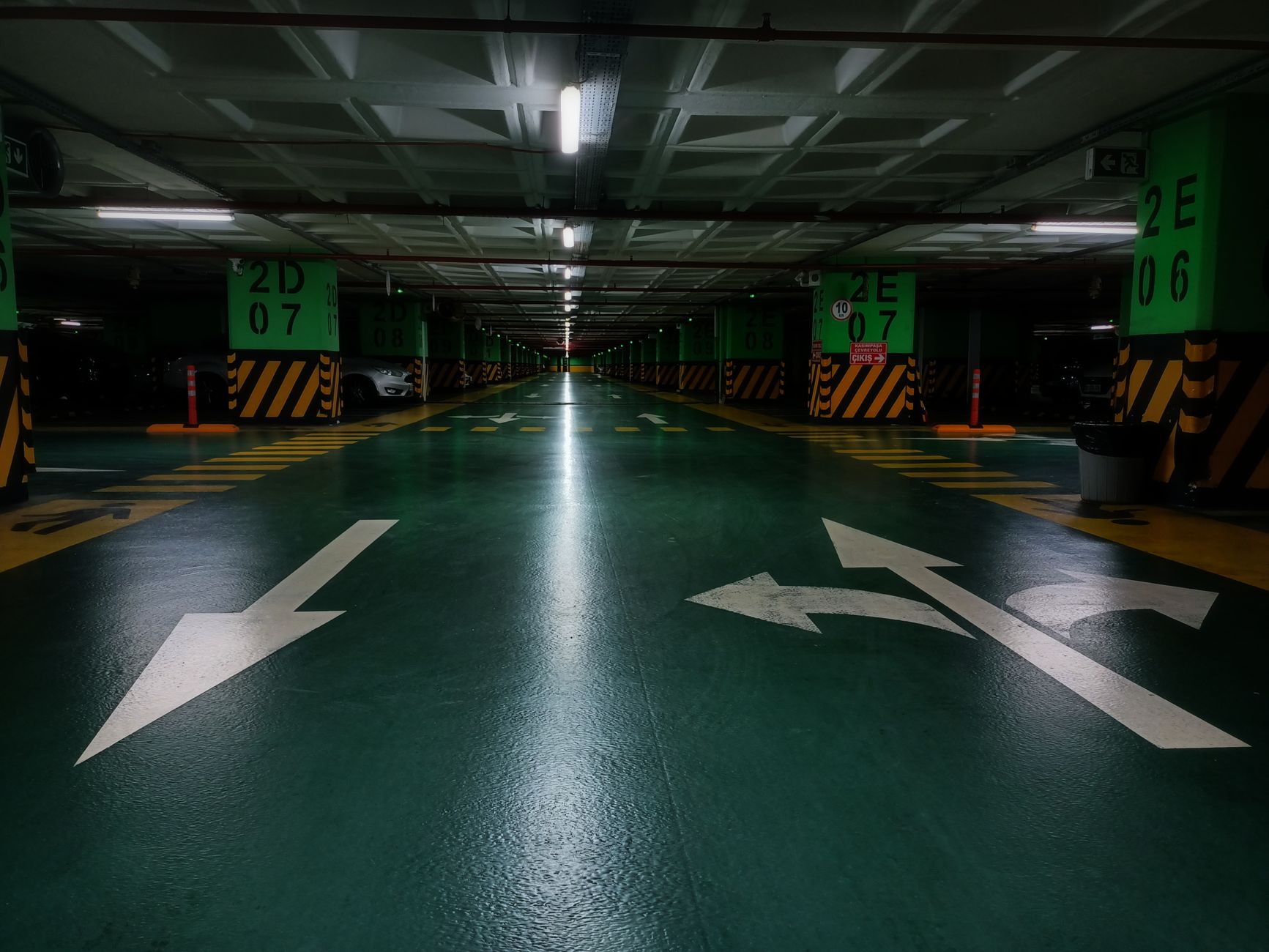
What Is the Difference Between 100% Solids Epoxy and Water-Based Epoxy?
100% solids epoxy contains zero water or solvents—every drop of material cures into a protective coating that bonds to your concrete. Water-based epoxy, by contrast, consists of only 30-50% solids by volume; the rest is water that evaporates during curing. The performance gap is dramatic: 100% solids epoxy cures to 8-12 mils of dry film thickness per coat, while water-based products achieve just 2-3 mils.
This thickness difference matters because garage floors face constant abuse from hot tires, spilled chemicals, and road salt tracked in from Wisconsin, Michigan, and Minnesota winters. A coating that's four times thicker delivers exponentially better protection. VOC levels tell another story: despite the stronger smell during application, 100% solids epoxy produces low or zero volatile organic compounds once cured. Water-based products market themselves as "low-odor," but that thin build means you're trading convenience for performance that won't hold up to real-world conditions.
Composition: Pure Resin vs. Water Carrier
100% solids epoxy is exactly what the name suggests: epoxy resin plus hardener, nothing else. When you mix the two components, a chemical reaction creates cross-linked molecular bonds that form an impervious surface layer. Water-based epoxy suspends microscopic epoxy particles in water, requiring that water to evaporate before the coating can begin to cure.
The result is a weaker molecular structure. Solids epoxy bonds chemically at full strength across the entire thickness of the coating. Water-based systems rely on evaporation first, then incomplete cross-linking, leaving gaps at the molecular level where moisture, salts, and chemicals can penetrate. That's why big-box store kits—almost always water-based—look good for six months, then start peeling near the garage door where salt and moisture concentrate.
Thickness and Build Per Coat
A single coat of 100% solids epoxy delivers 8-12 mils of dry film thickness (DFT). Water-based coatings manage only 2-3 mils per coat. To achieve equivalent protection, you'd need to apply 3-4 coats of water-based product—and even then, the chemical resistance and abrasion durability won't match.
Big-box DIY kits lean heavily on water-based formulations because they're easier to market as beginner-friendly projects. But ease of application doesn't translate to longevity. When you're paying for materials, sacrificing your garage for multiple days of drying time, and investing your own labor, the last thing you want is a floor that chips and yellows before you've finished paying off the car sitting on it.
Why Does 100% Solids Epoxy Outperform in Northwoods Winters?
Harsh Northwoods winters deliver the trifecta of garage floor destruction: road salt laden with calcium chloride and magnesium chloride, freeze-thaw cycling that makes concrete expand and contract, and summer heat that causes hot tire pickup. 100% solids epoxy resists salt penetration, thermal shock, and chemical etching because its dense molecular structure leaves no pathways for moisture or corrosives to reach the concrete substrate. Water-based coatings show premature wear, delamination, and yellowing under identical conditions—often within a single winter season.
Real-world testing proves the gap. 100% solids epoxy maintains bond integrity at temperatures below 0°F, flexing with the concrete as it contracts. Water-based coatings become brittle in freezing temperatures, cracking along stress points and allowing moisture to seep underneath. That moisture freezes, expands, and pops the coating off in sheets. It's not a question of if water-based will fail in a Wisconsin garage—it's when.
Chemical Resistance: Salt, Oil, and De-Icers
100% solids epoxy is impervious to automotive fluids including brake fluid, gasoline, antifreeze, and the salt brine that drips off your vehicle all winter. The dense cross-linked structure repels these chemicals, preventing staining and substrate damage. Water-based coatings absorb moisture by design—they're water-compatible during application, which means they remain somewhat permeable after curing.
That permeability allows road salts and de-icers to penetrate the coating, reaching the concrete beneath. Once there, salts crystallize, expand, and cause surface pitting. Within 12-24 months in a high-traffic garage, you'll see spalling, discoloration, and bond failure concentrated in the areas where you park. The coating that promised easy maintenance becomes a maintenance nightmare.
Thermal Expansion and Freeze-Thaw Cycles
Concrete expands and contracts with temperature changes. Wisconsin, Michigan, and Minnesota garages routinely experience 40-60°F daily temperature swings during spring and fall transitions. 100% solids epoxy flexes with the substrate thanks to superior adhesion—tensile strength exceeding 400 psi means the coating moves as one with the concrete rather than fighting against it.
Water-based epoxy achieves lower adhesion strength, typically under 250 psi. When the concrete expands in heat or contracts in cold, the coating can't maintain its bond. Cracks appear first along control joints and garage door thresholds, then spread across the surface. Once the bond breaks, moisture intrusion accelerates, and you're looking at full delamination. Premium epoxy garage floors built with 100% solids systems avoid this failure mode entirely.
How Long Does Each Type of Epoxy Last?
100% solids epoxy lasts 10-20+ years in residential garages with proper surface preparation, and 7-10 years in high-traffic commercial applications. Water-based epoxy delivers 2-5 years in residential settings under ideal conditions, but only 1-2 years in commercial environments or garages exposed to winter salt and chemicals. The difference isn't marginal—it's the gap between a one-time investment and a recurring maintenance headache.
Professional installers use 100% solids for commercial and industrial projects because facility managers demand durability, not marketing claims. Water-based coatings get relegated to light-duty applications or temporary surfaces where the coating will be replaced as part of a planned renovation cycle. For a garage floor you expect to outlast your current vehicle, the choice is clear.
Real-World Lifespan in Wisconsin, Michigan, and Minnesota Garages
Revolution Epoxy has installed hundreds of 100% solids epoxy floors across the Northwoods region. Projects completed five or more years ago show minimal wear—light scratches from dragged tools, perhaps, but no delamination, no discoloration, and full chemical resistance intact. Clients report that the floor still looks showroom-ready after multiple Wisconsin winters of salt exposure.
Water-based DIY jobs tell a different story. Within 18 months, delamination appears near garage door tracks where moisture and salt concentrate. Yellowing spreads from UV exposure through windows. The textured finish that promised slip resistance wears smooth in tire paths, becoming a slick hazard when wet. Most homeowners who installed big-box kits end up calling for professional removal and re-installation with commercial-grade 100% solids epoxy—paying twice to get it right.
Warranty differences reflect this reality. Professional 100% solids installations like those from Revolution Epoxy come backed by multi-year satisfaction guarantees. Big-box water-based kits offer limited or no warranty coverage, and what coverage exists often excludes the failure modes that actually occur: peeling, chemical damage, and moisture-related delamination.
Installation: Which Is Easier and Faster?
Water-based epoxy gets marketed as DIY-friendly due to lower odor during application and water cleanup. But "easier to apply" doesn't mean faster or better results. Water-based systems require multiple coats to build adequate thickness, with 12-24 hours of drying time between coats. Total cure time to full hardness stretches 5-7 days, and surface prep remains just as critical—skip the diamond grinding, and even the best coating will fail.
100% solids epoxy requires professional installation, but Revolution Epoxy completes the entire job in 1-2 days from surface prep to topcoat. Cure time allows light foot traffic within 24-72 hours and full vehicle traffic in 7 days. The speed advantage comes from proper equipment, experienced crews, and a coating system designed for single- or double-coat application. You get your garage back faster, and the floor performs better from day one.
Application Complexity and Equipment
100% solids epoxy demands experience. The material has a working time of 30-45 minutes after mixing, requiring fast, precise application. Professional installers use spiked shoes to walk on wet epoxy, notched squeegees to control thickness, and powered mixers to ensure complete chemical reaction between resin and hardener. Get the mix ratio wrong or leave unmixed material in the container, and you'll have soft spots that never fully cure.
Water-based epoxy offers a longer working time—2-3 hours—and roller application that feels familiar to anyone who's painted a room. The tradeoff: you'll need 3-4 coats to achieve protective thickness, with meticulous attention to dry times between coats. Extended downtime offsets the application ease. A DIY water-based project typically requires 3-5 days of garage access, multiple trips to the hardware store for additional materials, and the nagging uncertainty about whether your surface prep was adequate.
Revolution Epoxy completes 100% solids installations in 1-2 days because we control every variable: diamond-ground surface prep that opens the concrete pores, moisture testing to confirm readiness, climate-controlled material storage, and crews trained on fast-cure systems. The result is a floor that meets commercial performance standards without the learning curve.
Cost Comparison: Upfront Price vs. Long-Term Value
Water-based epoxy kits cost $0.50-$1.50 per square foot in materials alone, not counting your labor, tools, or the risk of costly mistakes. 100% solids epoxy professionally installed runs $3-$8 per square foot, all-in. The upfront gap looks significant until you calculate cost per year of service.
Over a 10-year lifespan, 100% solids epoxy costs $0.30-$0.80 per square foot per year. Water-based systems last 2-3 years before requiring removal and replacement, working out to $0.25-$0.75/sq ft/year at first glance. But factor in removal costs ($1-$2/sq ft to chemically strip or grind off failed coating), prep materials, and labor for the redo, and the real cost doubles. You'll spend more over five years with water-based than you would have spent once on commercial-grade 100% solids.
Position 100% solids as the one-and-done investment. You pay for professional installation, you get a floor engineered for Northwoods winters, and you don't think about it again for a decade or more. Transform your garage with Revolution Epoxy and eliminate the cycle of patch-and-replace that defines the water-based experience.
Hidden Costs of Water-Based Failure
When water-based epoxy fails, you can't simply coat over it. The delaminated material must be chemically stripped or mechanically ground off before applying a new system. That removal process adds $1-$2 per square foot to your total project cost. You'll also lose time—another multi-day garage shutdown—and generate waste that requires proper disposal.
Downtime has value. Every weekend spent recoating your garage is a weekend you can't use it for projects, storage, or parking. Repeated surface prep damages the concrete substrate through aggressive chemical stripping or over-grinding, reducing the quality of the bonding surface for the next coating. Eventually, you're left with a compromised slab that may require resurfacing before any coating will adhere properly.
Resale value matters, too. Homebuyers in Wisconsin, Michigan, and Minnesota recognize the difference between a professional epoxy floor and a peeling DIY job. A high-quality 100% solids floor with decorative vinyl flake or metallic finish reads as a premium upgrade. A water-based coating with visible wear and delamination signals deferred maintenance and raises questions about what else might have been done on the cheap.
Which Epoxy Should You Choose for Your Garage Floor?
If you operate a light-duty workshop in a climate-controlled space with no vehicle traffic or chemical exposure, water-based epoxy might be acceptable. For daily-driver garages in Wisconsin, Michigan, and Minnesota facing winter salt, freeze-thaw cycles, and automotive fluids, 100% solids epoxy is non-negotiable. The climate demands it, the performance justifies it, and the longevity pays for it.
Revolution Epoxy recommends commercial-grade 100% solids for all Northwoods residential garages. Our decorative options—vinyl flake systems that deliver slip resistance and visual depth, or metallic finishes that create unique reflective patterns—are only available in 100% solids formulations. Water-based systems can't support these high-end aesthetics because they lack the thickness and chemical compatibility required for broadcast aggregates and metallic pigments.
The decision matrix is straightforward. Ask yourself: do I need this floor to last through one winter or ten? Will I expose it to road salt, oil changes, and daily vehicle traffic? Do I want a garage that looks showroom-ready or merely acceptable? If durability, chemical resistance, and visual impact matter, 100% solids epoxy is the only answer.
When Water-Based Makes Sense (and When It Doesn't)
Water-based epoxy suits specific applications: interior basement floors with no chemical exposure, craft rooms or studios where aesthetics matter less than cost, or temporary surfaces scheduled for replacement within a known timeframe. In these controlled environments, the thinner build and lower chemical resistance may be acceptable tradeoffs for reduced material cost and simpler application.
Water-based is NOT suitable for garages with vehicle traffic, spaces exposed to freeze-thaw cycling, areas where chemicals or automotive fluids are present, or any application where you expect more than a 3-year lifespan. The coating will fail—not might fail, will fail—under these conditions. Moisture intrusion, salt damage, and thermal cycling will break the bond, and you'll be back to bare concrete within 18-24 months.
Revolution Epoxy does not install water-based coatings in garages. It's a solids-only policy driven by customer satisfaction and professional reputation. We've seen too many failed big-box installations, too many homeowners frustrated by delamination and discoloration, too many garages that needed complete removal and reinstallation within two years. When you're engineering floors for Northwoods winters, compromise isn't an option. Get a free quote from Revolution Epoxy and invest in a floor built to perform for decades, not seasons.
Frequently Asked Questions
Is 100% solids epoxy better than water-based for garage floors?
Yes. 100% solids epoxy delivers 8-12 mils of cured thickness per coat compared to 2-3 mils for water-based products, providing superior chemical resistance, abrasion durability, and bond strength. In Wisconsin, Michigan, and Minnesota garages exposed to road salt, freeze-thaw cycles, and automotive chemicals, 100% solids epoxy lasts 10-20+ years while water-based coatings often fail within 2-5 years due to moisture intrusion and delamination.
How long does water-based epoxy last on a garage floor?
Water-based epoxy typically lasts 2-5 years in residential garages under ideal conditions, but only 1-2 years in high-traffic or chemically exposed environments. In Northwoods climates with road salt and freeze-thaw cycles, water-based coatings frequently delaminate or yellow within 18 months. The thinner build (2-3 mils per coat) and lower chemical resistance make water-based unsuitable for garages with regular vehicle use and winter salt exposure.
Why is 100% solids epoxy more expensive?
100% solids epoxy costs $3-$8 per square foot installed because it contains zero fillers or solvents—every ounce cures into protective coating. Professional application requires specialized equipment, diamond-ground surface prep, and experienced installers. Water-based DIY kits cost $0.50-$1.50/sq ft in materials but require multiple coats, deliver inferior performance, and often need removal and replacement within 3 years, making solids epoxy the better long-term value.
Can I apply 100% solids epoxy myself?
100% solids epoxy is challenging for DIYers due to a 30-45 minute working time, precise mixing ratios, and the need for professional surface preparation (diamond grinding or shot blasting). Improper prep or application leads to bubbles, uneven thickness, or delamination. Revolution Epoxy completes professional 100% solids installations in 1-2 days with proper prep, ensuring the floor achieves its full 10-20 year lifespan and performance specifications.
Does water-based epoxy work in cold climates?
Water-based epoxy performs poorly in cold climates like Wisconsin, Michigan, and Minnesota. It lacks the chemical resistance to withstand road salt, calcium chloride, and magnesium chloride de-icers. Freeze-thaw cycling causes water-based coatings to crack and peel due to lower adhesion strength (under 250 psi vs. 400+ psi for solids). Moisture absorption accelerates failure. For garages in the Northwoods region, 100% solids epoxy is the only coating engineered to handle harsh winter conditions.
How thick is 100% solids epoxy compared to water-based?
100% solids epoxy cures to 8-12 mils (0.008-0.012 inches) of dry film thickness per coat. Water-based epoxy achieves only 2-3 mils per coat because 50-70% of the product is water that evaporates during curing. To match the protection of one coat of 100% solids, you would need 3-4 coats of water-based epoxy, extending installation time and increasing labor while still delivering inferior chemical and abrasion resistance.
What is the best epoxy for Wisconsin garage floors?
The best epoxy for Wisconsin garage floors is commercial-grade 100% solids epoxy, specifically engineered to resist road salt, de-icers, and freeze-thaw cycles. Revolution Epoxy installs only 100% solids systems with decorative vinyl flake or metallic finishes, providing slip resistance, chemical impermeability, and 10-20+ year durability. Water-based and big-box store kits fail prematurely under Wisconsin's winter conditions, making professional-grade solids epoxy the proven choice for long-lasting garage transformations.