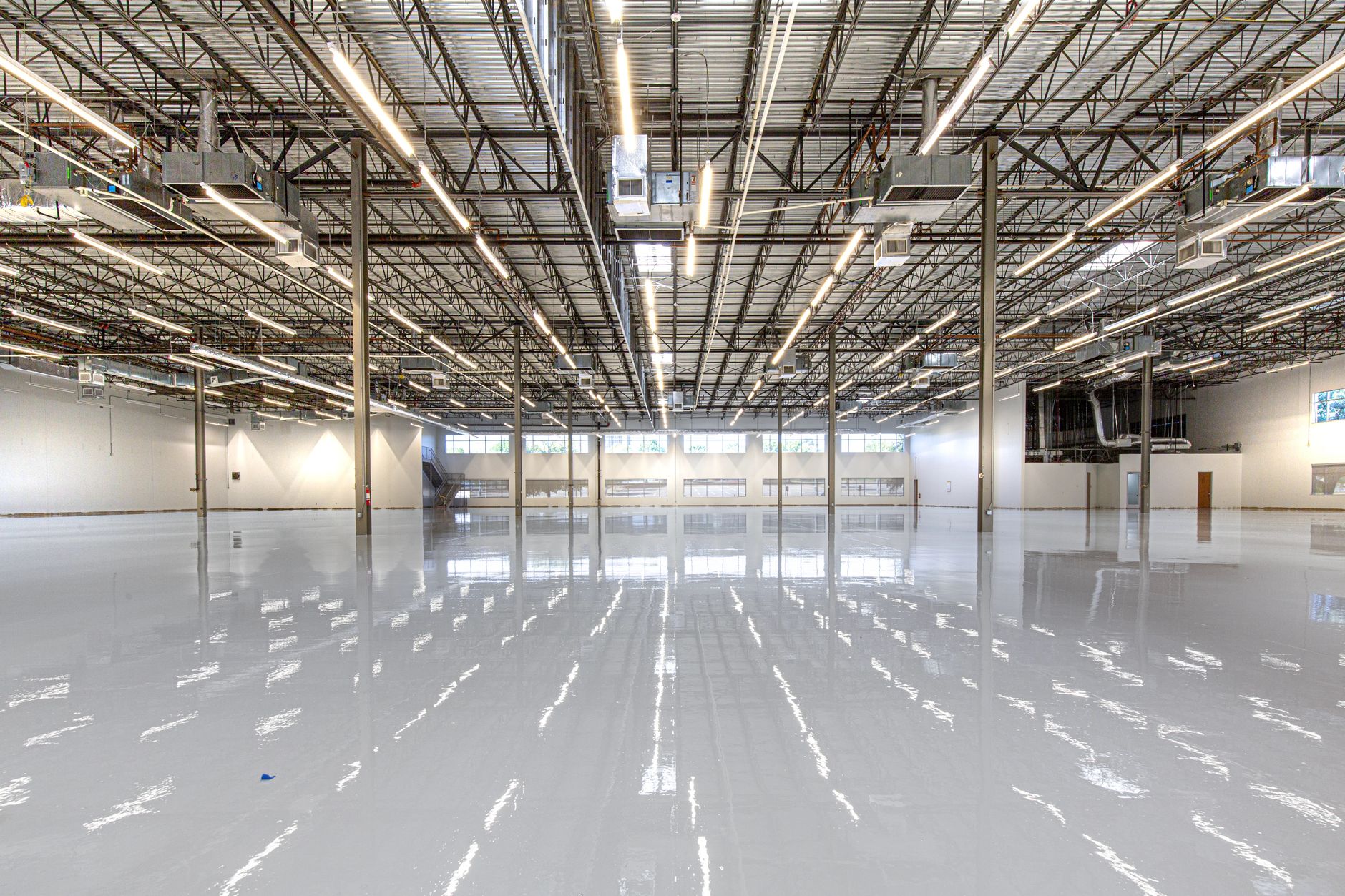
Professional-grade 100% solids epoxy flooring is chemically inert to road salt, calcium chloride, magnesium chloride, and all common de-icing chemicals used across Wisconsin, Michigan, and Minnesota. The cross-linked polymer structure creates a non-porous barrier that prevents salt or moisture penetration, meaning road salt simply sits on the surface and rinses away without causing pitting, discoloration, or deterioration. Cheap box-store epoxy kits with low solids content will fail under salt exposure, but commercial systems engineered for Northwoods winters handle decades of heavy chemical contact without degradation.
Does Road Salt Damage Professional-Grade Epoxy Floors?
No—100% solids commercial epoxy is chemically resistant to sodium chloride (rock salt), calcium chloride, and magnesium chloride at any concentration. The molecular bond density in professional epoxy creates an impermeable surface that salt cannot penetrate or chemically alter.
Water-based or low-solids coatings (30-50% solids content) absorb moisture and salt through their porous structure, leading to delamination, yellowing, and surface breakdown within 1-2 winters. These products are designed for foot traffic in basements, not vehicle traffic and chemical exposure in garages. Professional epoxy systems are rated for chemical resistance across pH 2-12, which covers everything from battery acid to concrete cleaners to road salt slush.
Revolution Epoxy's flooring systems use the same 100% solids epoxy formulations found in commercial warehouses and industrial loading docks—environments where chemical exposure is constant and failures are expensive. The system is specifically engineered for Northwoods winter conditions, where vehicles track in salt, sand, de-icers, and slush from November through April.
The Science: Why 100% Solids Epoxy Resists Salt and De-Icers
The cross-linked polymer structure in cured epoxy forms a dense, three-dimensional molecular network with zero porosity. This creates a physical barrier that prevents moisture wicking and chemical absorption. When salt contacts the surface, it has nowhere to go—no pores to enter, no weak points to exploit.
Compare this to concrete, which is inherently porous with microscopic channels and capillaries throughout. Untreated concrete absorbs both water and dissolved salt, which then crystallizes during freeze-thaw cycles and causes spalling (surface flaking) and deterioration. The curing process for 100% solids epoxy creates a chemical bond with the concrete substrate that's approximately 3 times stronger than the concrete itself, meaning the epoxy won't separate even under extreme thermal stress.
Commercial and industrial facilities rely on epoxy precisely because of this chemical resistance. Loading docks exposed to road chemicals year-round, automotive service bays handling motor oil and brake fluid, and food processing plants using aggressive sanitizers all use the same epoxy chemistry. If the material can handle daily chemical exposure in a distribution warehouse, your garage's seasonal salt contact is negligible by comparison.
Box-Store Epoxy Kits: Where Salt Resistance Falls Apart
Water-based epoxy kits sold at big-box retailers contain 30-50% solids, with the remainder being water and fillers. This porous structure allows moisture penetration, and when that moisture contains dissolved salt, the coating breaks down from within. Typical failures include peeling at seams, yellowing, and surface pitting—often visible after just one winter.
Thickness matters critically for chemical resistance. Box kits apply at 2-3 mils (roughly the thickness of a piece of paper), while professional systems install at 10-20 mils (3-5 credit cards stacked). The thin barrier simply doesn't provide enough material to resist abrasion from sand and repeated chemical contact. These products are rated for foot traffic in climate-controlled basements, not the harsh conditions of a Northwoods garage.
Inadequate surface preparation compounds the problem. Box kits rely on homeowners using muriatic acid to etch concrete—a process that creates minimal surface profile and poor mechanical adhesion. When the concrete undergoes thermal cycling (expansion and contraction from temperature swings), that weak bond fails first. Salt doesn't cause the delamination, but it accelerates existing weaknesses by introducing moisture at the bond line.
The failure timeline is predictable: first winter shows edge peeling where moisture enters, second winter brings widespread delamination in tire tracks, third winter requires complete removal and reinstallation. Professional epoxy installed correctly lasts 10-15 years in the same conditions.
What Actually Damages Epoxy Floors in Winter Conditions?
Improper installation causes the vast majority of winter epoxy failures, not salt exposure. If epoxy is applied over concrete containing trapped moisture, freeze-thaw cycles will cause delamination regardless of surface chemical contact. Professional installers perform calcium chloride moisture emission tests and relative humidity tests before application—moisture levels above 3 pounds per 1,000 square feet per 24 hours require remediation before epoxy installation.
Using epoxy not rated for thermal cycling creates cracking and adhesion failure. Northwoods garages experience temperature swings from -20°F on winter nights to 80°F on sunny afternoons, a 100-degree differential that causes concrete expansion and contraction. Epoxy systems must have sufficient flex modulus to move with the substrate without cracking. Rigid coatings designed for stable indoor temperatures will fail in these conditions.
Additional failure points include:
- Applying topcoat without UV inhibitors, leading to yellowing from sunlight exposure through garage doors
- Skipping slip-resistant additives, creating a safety hazard when wet or icy conditions are tracked indoors
- Installing during improper temperature ranges (most epoxies require 50-90°F ambient and substrate temperature during cure)
- Failing to diamond grind or shot blast for proper surface profile (acid etching alone is inadequate)
Hot tire pickup—where tires soften the epoxy surface on hot days—is a separate issue unrelated to winter salt exposure. This occurs with improperly formulated or under-cured epoxy, and quality systems with correct hardener ratios eliminate this problem. Salt itself is chemically inert to properly installed professional epoxy; the coating's durability failures stem from installation shortcuts and inferior materials.
Thermal Cycling and Freeze-Thaw: The Real Winter Challenge
Temperature swings from -20°F to 80°F cause concrete to expand and contract by approximately 0.0055 inches per 10 feet of slab per 100-degree temperature change. Professional epoxy systems are engineered with flex modulus to accommodate this movement without cracking or delaminating. The material moves with the concrete substrate rather than fighting against it.
Commercial-grade epoxy is rated for service temperatures from -40°F to 140°F, well beyond what Northwoods garages experience. This temperature tolerance is critical—cheap coatings become brittle in extreme cold and lose adhesion, while professional systems maintain flexibility and bond strength across the entire range.
Freeze-thaw cycles affect the concrete substrate more than the epoxy coating. When moisture in concrete freezes, it expands by approximately 9%, creating internal pressure. Unsealed concrete deteriorates rapidly under these conditions—hence the spalling and pitting visible on driveways and sidewalks after 5-10 winters. Properly installed epoxy seals the concrete completely, eliminating moisture intrusion and preventing freeze-thaw damage to the substrate.
This is why moisture testing before installation is non-negotiable. Concrete that appears dry on the surface can harbor significant moisture in the lower slab layers, especially in basements and garages with insufficient vapor barriers. Installing epoxy over wet concrete traps that moisture, and when it freezes, the expanding ice will delaminate even the strongest epoxy bond. Professional installers wait for correct moisture readings or use moisture mitigation primers when necessary.
How to Maintain Epoxy Floors Exposed to Road Salt
Sweep or blow out salt and sand debris weekly during winter months. This removes abrasive particles that cause minor surface wear over time—the maintenance is about appearance and preventing scratches, not chemical damage. A simple shop broom or leaf blower takes 5 minutes and keeps the floor showroom-clean.
Mop with a pH-neutral cleaner and warm water weekly to remove salt residue and tracked-in grime. Mix 2-3 ounces of mild dish soap or dedicated epoxy floor cleaner per gallon of water. The cleaning is cosmetic—salt residue dulls the high-gloss finish but doesn't etch or corrode the epoxy. A standard mop or microfiber pad removes buildup easily.
Avoid these practices that can dull or scratch the finish:
- Harsh alkaline degreasers with pH above 10 (unnecessary for routine cleaning and can degrade topcoat over years of use)
- Metal shovels or snow scrapers dragged across the surface (use plastic or rubber edges instead)
- Leaving salt slush to sit for days or weeks (cosmetic issue only, but harder to remove once dried)
- Acidic cleaners like vinegar or muriatic acid (no benefit for salt removal and can dull gloss)
The reassurance Northwoods homeowners need: properly installed 100% solids epoxy requires no resealing or recoating for 10-15 years even with heavy salt exposure. The coating is permanent and chemically inert. You're maintaining it for appearance, not protecting it from degradation.
When to Rinse vs. When to Ignore Salt Residue
White salt residue is purely cosmetic—it doesn't harm the epoxy surface but creates a hazy, dulled appearance that hides the floor's depth and gloss. A quick rinse with a garden hose (when temperatures allow) or damp mopping removes fresh residue in seconds. If the garage is heated or you mop immediately after parking, dried residue wipes away easily.
Salt that sits for 2-3 weeks may require light scrubbing with a soft brush and pH-neutral cleaner. The salt hasn't bonded to or etched the epoxy—it's simply dried in layers. Compare this to untreated concrete, where salt solution penetrates the pores and accelerates spalling and deterioration. Epoxy eliminates this concern entirely; the salt stays on the surface where it's easily removed.
The slip-resistant texture in premium epoxy garage floors from Revolution Epoxy means there's no safety compromise even when wet salt residue is present. The aluminum oxide additive creates grip regardless of surface moisture, unlike smooth painted concrete or untreated slabs that become ice-rink slippery when wet.
Revolution Epoxy: Engineered for Northwoods Winters and Road Chemicals
Revolution Epoxy's flooring system uses 100% solids epoxy with zero water content—the same material specification used in commercial and industrial applications. The 10-20 mil thickness (roughly 3-5 credit cards stacked) provides chemical resistance, impact durability, and the thermal flexibility to handle -40°F to 140°F temperature extremes without cracking or delaminating.
The chemical-resistant topcoat is rated for automotive fluids (motor oil, gasoline, brake fluid, antifreeze), road de-icers (sodium chloride, calcium chloride, magnesium chloride), and common garage chemicals across pH 2-12. This isn't marketing language—it's the same spec sheet commercial facilities require when epoxy floors handle daily chemical exposure.
Installation process ensures winter performance:
- Concrete moisture testing (calcium chloride and relative humidity tests) prevents moisture-related delamination
- Diamond grinding creates 100-200 micron surface profile for mechanical bond (far superior to acid etching)
- Climate-appropriate cure times account for temperature and humidity conditions
- Aluminum oxide slip-resistant additive rated for wet and icy conditions
- Satisfaction guarantee backed by hundreds of Northwoods installations
The 1-2 day installation timeline means your garage is back in service quickly—critical during Wisconsin, Michigan, and Minnesota winters when outdoor storage isn't an option. Revolution Epoxy serves the entire Northwoods region with installers who understand local climate challenges and specify materials accordingly.
National franchises often use thinner systems (6-8 mils) to improve profit margins, and big-box kits rarely exceed 3 mils. The thickness difference translates directly to durability. When you're investing in a garage transformation that should last 10-15 years, the material quality and installation expertise matter more than the initial price.
Choosing a Salt-Resistant Garage Floor: What to Ask Your Installer
Demand specific answers about solids content—100% solids epoxy is the only formulation that provides true chemical resistance and durability. If an installer deflects or mentions "high solids" without a percentage, assume they're using water-based or low-solids products. Request the product data sheet that shows solids content by volume.
Ask about mil thickness and get it in writing. Professional installations should guarantee 10 mils minimum, with most quality systems applying 12-20 mils total (base coat plus topcoat). Measure it yourself if needed—wet film thickness gauges cost less than $20 and verify the installer is applying adequate material.
Additional questions that separate professionals from cheap alternatives:
- Do you test concrete moisture before installation? (Correct answer: yes, using calcium chloride test and/or relative humidity meter)
- What is the thermal cycling rating of your epoxy? (Should handle -40°F to 140°F minimum)
- What surface preparation method do you use? (Correct answer: diamond grinding or shot blasting, not acid etching alone)
- Can you provide references from customers with 3+ winters on their floors? (Verifiable local references matter more than online reviews)
- What is your product's chemical resistance spec? (Should specify pH range and specific chemicals)
Red flags that indicate inferior systems or installation:
- Vague answers about product specifications ("We use the best epoxy available")
- Price significantly cheaper than competitors (often indicates thin application or low-solids product)
- Same-day cure promises in cold weather (proper epoxy requires 24-72 hours cure time depending on temperature)
- Refusal to provide product data sheets or manufacturer information
- Pressure tactics or limited-time discounts that expire immediately
Transform your garage with Revolution Epoxy—installers who understand Northwoods winters and specify materials that handle road salt, thermal cycling, and heavy use for 10-15 years without recoating. The investment pays for itself in durability and eliminates the expense and hassle of recoating every 2-3 years.
Frequently Asked Questions
Will road salt ruin my epoxy garage floor?
No. Professional-grade 100% solids epoxy is chemically inert to road salt (sodium chloride), calcium chloride, magnesium chloride, and other common de-icers. The cross-linked polymer creates a non-porous barrier that prevents salt or moisture penetration. Cheap box-store kits with low solids content will fail under salt exposure, but commercial epoxy systems like Revolution Epoxy's are engineered specifically for harsh Northwoods winters and heavy chemical contact.
How does epoxy compare to concrete for salt resistance?
Epoxy is vastly superior. Concrete is porous and absorbs both moisture and salt, leading to spalling, pitting, and surface deterioration—especially during freeze-thaw cycles. A properly installed 100% solids epoxy floor seals the concrete completely, eliminating salt absorption. The epoxy surface itself is impermeable and chemically resistant, so salt simply sits on top and rinses away without causing damage. This is why commercial warehouses and loading docks use epoxy in high-salt environments.
Do I need to rinse road salt off my epoxy floor immediately?
No, but regular cleaning improves appearance. Road salt won't chemically damage or etch epoxy, so there's no urgency. However, dried salt leaves a white residue that dulls the finish. A quick rinse with a hose or damp mop once or twice a week during winter keeps the floor looking showroom-clean. If salt sits for weeks, it may require light scrubbing with a pH-neutral cleaner. The key point: you're cleaning for aesthetics, not to prevent damage.
What actually damages epoxy floors in winter—if not salt?
The real threats are improper installation and low-quality products. If epoxy is applied over concrete with trapped moisture, freeze-thaw cycles will cause delamination. If the epoxy isn't rated for extreme temperature swings (-20°F to 80°F), it will crack. Thin coatings (under 10 mils) or water-based formulas lack the durability for thermal cycling and chemical exposure. Salt accelerates these existing weaknesses but doesn't harm a correctly installed, commercial-grade system. Professional installers test concrete moisture and use climate-appropriate materials to prevent winter failures.
How thick should epoxy be to resist road salt and winter conditions?
Professional epoxy should be at least 10-20 mils thick (roughly the thickness of 3-5 credit cards stacked). This thickness provides chemical resistance, impact durability, and flexibility to handle thermal expansion and contraction. Box-store kits typically apply at 2-3 mils, which is inadequate for vehicle traffic and chemical exposure. Revolution Epoxy installs commercial-grade systems at 10-20 mils, ensuring the floor withstands Northwoods winters, road salt, automotive fluids, and heavy use for 10-15 years without recoating.
Can I use any cleaner on my epoxy floor after tracking in salt?
Use pH-neutral cleaners only. Warm water and a mild dish soap or dedicated epoxy floor cleaner work best. Avoid harsh alkaline degreasers (pH above 10) or acidic cleaners, which can dull the topcoat over time. For routine winter maintenance, sweeping or blowing out salt and sand debris prevents abrasive wear, then mopping with warm water removes residue. The epoxy itself is chemically resistant, but using gentle cleaners preserves the high-gloss finish and extends the life of the slip-resistant topcoat.
Does Revolution Epoxy's flooring handle Wisconsin, Michigan, and Minnesota winters?
Yes—it's specifically engineered for Northwoods conditions. Revolution Epoxy uses 100% solids commercial-grade epoxy with a chemical-resistant topcoat rated for road salt, de-icers, automotive fluids, and temperature extremes from -40°F to 140°F. The slip-resistant aluminum oxide additive ensures safety even when wet or icy. Installation includes moisture testing and diamond grinding to ensure proper adhesion, and the system is proven in harsh regional climates. Customers across Wisconsin, Michigan, and Minnesota report zero salt-related damage after multiple winters, with floors maintaining showroom appearance for 10-15 years.