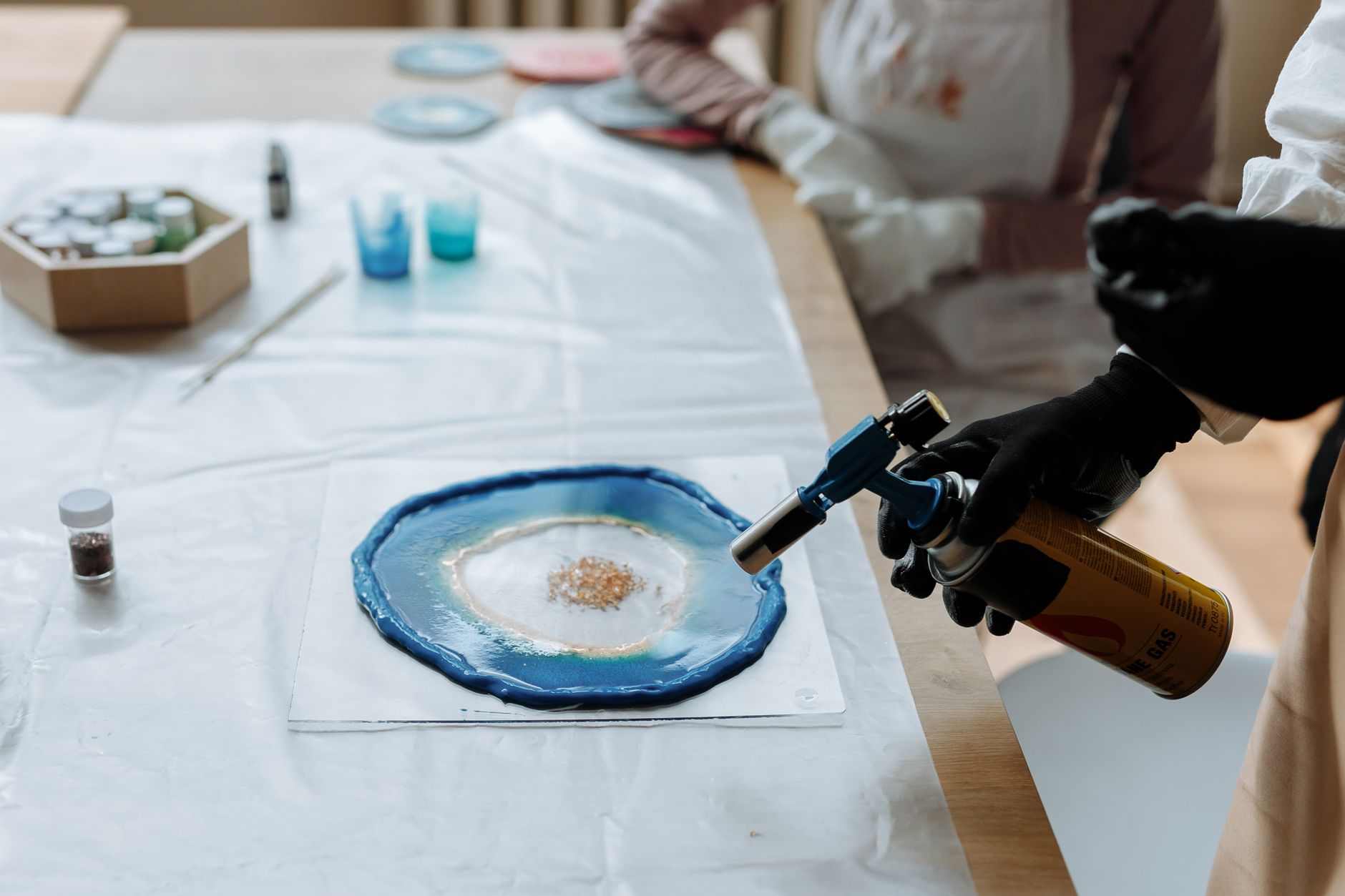
DIY epoxy garage floor kits cost $200-$800 in materials alone, but the true all-in expense—including surface prep tools, hidden supplies, and your labor—pushes total cost to $1,200-$2,000 for a typical two-car garage in 2026. When you factor in the 40-60% failure rate of big-box coatings in harsh Northwoods climates, many homeowners end up spending $2,500-$3,500 on do-overs, often exceeding the cost of professional 100% solids epoxy installation.
What is the upfront cost of DIY epoxy garage floor kits?
Big-box store epoxy kits range from $50 to $800 depending on coverage area and formulation. Rust-Oleum EpoxyShield runs $50-$150 for 250 square feet of single-coat coverage. Quikrete Epoxy Garage Floor Coating costs $200-$300 for 400 square feet. Premium DIY kits from brands like ArmorPoxy or Rust-Oleum Professional start at $400-$800 for similar coverage with thicker mil builds.
Most kits include a base epoxy coat, decorative color chips, and a topcoat sealer. What they don't include is the equipment and prep materials required for proper installation. A typical two-car garage (400 square feet) needs:
- Diamond grinder rental: $75-$150 per day (most hardware stores)
- Concrete patching compound: $30-$80 for cracks and spalling repair
- Industrial degreaser: $20-$50 for oil stain removal
- Mixing paddle and drill: $40-$60 if you don't own heavy-duty mixing tools
- Spiked shoes: $25 to walk on wet epoxy without marring
- Painters tape, buckets, squeegees, rollers: $50-$75 in miscellaneous supplies
When you add up materials and tools, expect to spend $600-$1,200 for your first attempt at coating a 400 square foot garage. For an 800 square foot three-car garage, double those figures to $1,200-$2,400.
Hidden tool and prep costs that double your budget
The coating kit is the smallest expense in a DIY epoxy project. Surface preparation demands professional-grade tools that most homeowners don't own and can't skip. Diamond grinding is non-negotiable—acid etching alone doesn't open concrete pores enough for proper adhesion in high-traffic garages exposed to thermal cycling and road salt.
A diamond grinder rental runs $75-$150 per day from equipment rental centers. Most first-time installers need two days to complete grinding, patching, and cleaning, pushing rental costs to $150-$300. Concrete patching compound for crack repair costs $30-$80 per gallon, and a typical garage needs 1-2 gallons. Industrial-strength degreaser ($20-$50) is essential for removing oil stains that cause adhesion failure.
Basement installations require a moisture meter ($30-$100) to test for vapor transmission—a common failure point when moisture migrates through concrete and lifts epoxy coatings. Disposal fees for removing old coatings add another $50-$100 if your garage already has a failed DIY or paint layer.
Total hidden costs: $300-$600 minimum, often more if you encounter moisture issues or extensive concrete damage. These expenses recur with every do-over attempt.
Labor cost: Your time has value
Surface preparation takes 8-12 hours of grinding, cleaning, patching, and etching concrete. Application requires 4-6 hours for mixing two-part epoxy, rolling base coats, broadcasting decorative chips, and applying topcoats. You'll also lose 24-72 hours of garage access during cure times—problematic if you park vehicles outside during Wisconsin or Michigan winters.
If you value your time at even $25 per hour, that's $300-$450 in labor cost for a DIY installation. Professionals complete the same job in 1-2 days with zero homeowner effort, specialized equipment, and commercial-grade materials engineered for Northwoods winters. Revolution Epoxy's premium epoxy flooring systems eliminate the physical labor, learning curve, and risk of application errors that plague first-time installers.
Why do most DIY epoxy floors fail in the Northwoods?
Big-box epoxy kits use water-based or 50-60% solids formulas that aren't engineered for Wisconsin, Michigan, and Minnesota freeze-thaw cycles. These thin coatings fail from inadequate surface prep, hot-tire pickup, road salt damage, and moisture vapor transmission. Water-based epoxy delivers only 20-40% of the abrasion resistance of commercial 100% solids epoxy, and studies show 40-60% of DIY garage floors in cold climates need re-coating within 2-3 years.
Common failure modes include:
- Delamination from poor surface prep: Acid etching alone doesn't open concrete pores enough for mechanical bonding. Epoxy lifts in sheets when exposed to thermal stress.
- Hot-tire pickup: Thin water-based coatings soften under the heat of parked tires, peeling away in tire-tread patterns within 6-12 months.
- Salt and de-icer chemical damage: Road salt, calcium chloride, and magnesium chloride corrode water-based epoxy coatings, causing white hazing and surface breakdown.
- Moisture vapor transmission: Concrete slabs naturally release moisture vapor. Without a vapor barrier primer, moisture migrates through the coating and causes blistering or delamination—especially in basement installations.
- UV yellowing: Water-based epoxy topcoats yellow under UV exposure from garage door openings, turning clear coats amber within 1-2 years.
The Northwoods climate demands commercial-grade 100% solids epoxy with polyaspartic topcoats, not consumer-grade products formulated for mild climates. Professional installers know how to diamond-grind concrete to the right profile, apply moisture mitigation primers, and select coatings engineered for sub-zero thermal cycling.
The do-over cost: When DIY goes wrong
A failed epoxy coating is harder to remove than bare concrete preparation. Grinding off peeling epoxy adds $500-$1,500 in equipment rental, abrasive discs, and disposal fees. You'll also need to purchase a second coating kit ($200-$800), bringing your total do-over cost to $700-$2,300 before you've even started the second attempt.
When you add the $600-$1,200 sunk cost from your first failed installation, total DIY expense reaches $1,300-$3,500 for two attempts at a 400 square foot garage. Many homeowners at this point hire professionals anyway, effectively paying twice—once for materials they can't use and again for the installation they should have ordered from the start.
Do-overs also compound physical labor. You've now invested 24-36 hours grinding, mixing, and applying coatings with nothing to show but a failed floor and sore muscles. The frustration factor alone drives most homeowners to Revolution Epoxy for a free quote after one DIY disaster.
How does DIY cost compare to professional epoxy installation?
Professional 100% solids epoxy with vinyl flake broadcast costs $3-$8 per square foot installed in Wisconsin, Michigan, and Minnesota. A 400 square foot two-car garage runs $1,200-$3,200, while an 800 square foot garage costs $2,400-$6,400. This includes diamond grinding, vapor barrier primer, 100% solids epoxy base, decorative flake broadcast, polyaspartic topcoat, slip-resistant aluminum oxide grit, and a satisfaction guarantee.
The upfront cost is 50-100% more than DIY kit pricing, but you're buying climate-engineered durability and eliminating the #1 failure point in DIY installations: improper surface preparation. Professional diamond grinding opens concrete pores 10x better than acid etching, creating the mechanical bond required for long-term adhesion under thermal cycling and chemical exposure.
ROI calculation: A professional epoxy floor lasts 15-20 years in the Northwoods versus 2-5 years for DIY water-based coatings. Divide a $2,400 professional installation by 18 years of service life, and you're paying $133 per year. A $1,200 DIY floor that fails after 3 years costs $400 per year—three times the annual cost of professional work. When you factor in do-over expenses ($1,300-$3,500), DIY lifetime cost often exceeds professional installation by 50-100%.
What you get with professional-grade materials
Commercial 100% solids epoxy contains zero water or solvents—just pure resin and hardener. This formulation delivers twice the coating thickness per gallon versus water-based products, with zero shrinkage during cure and no VOC emissions. The result is a dense, impermeable barrier that resists hot-tire pickup, chemical damage, and moisture transmission.
Polyaspartic topcoats provide UV stability that prevents yellowing, chemical resistance to road salt and de-icers, and rapid cure times (walk-on in 6-12 hours, vehicle traffic in 24 hours). Slip-resistant aluminum oxide grit embedded in the topcoat creates traction that exceeds bare concrete, even when wet—critical for winter safety when melting snow creates slippery conditions.
Professional systems are engineered for sub-zero thermal cycling. The epoxy remains flexible enough to expand and contract with concrete movement during freeze-thaw cycles without cracking or delaminating. Moisture mitigation primers bond to damp concrete and block vapor transmission—essential for basement installations where hydrostatic pressure pushes moisture upward through the slab.
You also get a commercial warranty versus zero warranty coverage on DIY kits. Big-box stores disclaim liability for improper installation (which most first-time installers inadvertently do). Commercial-grade epoxy options include multi-year warranties backed by professional installation verification.
When does DIY epoxy make financial sense?
DIY epoxy can work for small projects under 200 square feet in mild climates without freeze-thaw cycles or road salt exposure. A workshop corner, laundry room, or single-car garage in the southern U.S. may tolerate water-based coatings if you have prior concrete finishing experience and already own surface prep equipment.
Best-case scenarios for DIY include:
- Low-traffic areas: Workshops, storage rooms, or seasonal spaces where coating failure doesn't disrupt daily life
- Temporary flooring: Rental properties or flip projects where you need cosmetic improvement for 2-3 years, not 20-year durability
- Existing equipment: You already own a diamond grinder, moisture meter, and industrial mixing tools
- Small footprint: Projects under 200 square feet minimize material cost and reduce the risk of application errors
- Mild climates: Southern states without road salt, freeze-thaw cycles, or sub-zero temperatures
Even in these scenarios, upgrade to premium 100% solids kits like Rust-Oleum Professional or ArmorPoxy rather than consumer-grade water-based products. The incremental cost ($400-$800 versus $50-$150) buys significantly better abrasion resistance and chemical tolerance.
For Northwoods garages, basements, or any high-traffic area exposed to winter conditions, DIY epoxy rarely pencils out long-term. The combination of harsh winters, road salt, thermal cycling, and moisture transmission demands commercial-grade materials and professional surface prep—something big-box kits cannot reliably deliver.
What should Northwoods homeowners budget for a garage floor in 2026?
Professional epoxy installation pricing in Wisconsin, Michigan, and Minnesota reflects regional climate demands and commercial-grade material costs. Plan to spend $3-$8 per square foot for vinyl flake broadcast systems, with pricing variations based on garage size, concrete condition, and finish selection.
Typical project costs:
- Single-car garage (200-300 sq ft): $900-$2,400
- Two-car garage (400-600 sq ft): $1,600-$4,800
- Three-car garage (600-900 sq ft): $2,400-$7,200
Metallic epoxy finishes add 20-30% to base pricing due to specialized application techniques and premium metallic pigments that create three-dimensional depth. Broadcast quartz systems cost 25-35% more than vinyl flake due to heavier aggregate loading and additional topcoat layers required for stone-like texture and maximum abrasion resistance.
Basement floor installations run similar per-square-foot pricing but may require moisture mitigation primers that add $0.50-$1.50 per square foot. Basements built before 2000 often lack vapor barriers beneath the slab, making moisture mitigation essential to prevent coating failure from hydrostatic pressure.
Professional installation includes all surface preparation (diamond grinding, crack repair, oil stain removal), commercial-grade materials (100% solids epoxy, polyaspartic topcoat, slip-resistant grit), labor, and typically a 5-10 year warranty. Compare this to the $1,200-$2,000 all-in cost of DIY with high failure risk and zero warranty protection.
Most Northwoods homeowners find that investing $2,400-$4,800 in professional installation for a two-car garage delivers better value than risking $1,200-$2,000 on DIY with a 40-60% chance of needing a $1,300-$3,500 do-over within 3 years. The math favors professional work, especially when you factor in 18-20 year service life and elimination of physical labor.
Frequently Asked Questions
How much does a DIY epoxy garage floor kit cost?
DIY epoxy kits from big-box stores range from $50 to $800 depending on coverage and quality. A typical two-car garage (400 sq ft) requires $200-$300 in coating materials. However, you'll need to budget an additional $300-$600 for surface prep tools like grinder rentals, degreaser, patching compound, mixing equipment, and spiked shoes. The true all-in cost for a DIY epoxy floor is $600-$1,200 for materials and tools, not counting your labor time.
Why do DIY epoxy floors fail in Wisconsin, Michigan, and Minnesota?
Big-box epoxy kits use water-based or low-solids formulas (50-60% epoxy) that aren't engineered for harsh Northwoods winters. These thin coatings fail from inadequate surface prep, hot-tire pickup, road salt damage, freeze-thaw cycles, and moisture vapor transmission. Water-based epoxy has only 20-40% of the abrasion resistance of commercial 100% solids epoxy. Studies show 40-60% of DIY garage floors in cold climates need re-coating within 2-3 years due to delamination or chemical damage.
Is DIY epoxy cheaper than hiring a professional?
DIY appears cheaper upfront—$600-$1,200 for materials and tools versus $1,200-$3,200 for professional installation of a 400 sq ft garage. But when you factor in the 40-60% failure rate, do-over costs ($1,300-$3,500 to remove and recoat), and your labor time (12-18 hours at $25/hour = $300-$450), the real DIY cost often exceeds professional pricing. Professional floors last 15-20 years with commercial-grade materials and warranty protection, while DIY floors average 2-5 years in the Northwoods.
What hidden costs come with DIY epoxy flooring?
Beyond the kit price, expect to spend $300-$600 on essential tools and materials: diamond grinder rental ($75-$150/day), concrete patching compound ($30-$80), industrial degreaser ($20-$50), moisture meter ($30-$100), mixing paddle and drill ($40-$60), spiked shoes ($25), and miscellaneous supplies ($50-$75). If your first attempt fails, removal and re-coating adds another $1,300-$3,500. Many homeowners also underestimate the value of 12-18 hours of physical labor required for proper surface prep and application.
How much does professional epoxy garage floor installation cost in 2026?
Professional 100% solids epoxy with vinyl flake broadcast costs $3-$8 per square foot installed in Wisconsin, Michigan, and Minnesota. A two-car garage (400 sq ft) runs $1,200-$3,200, while an 800 sq ft garage costs $2,400-$6,400. This includes diamond grinding, vapor barrier primer, commercial-grade epoxy base, decorative flake, polyaspartic topcoat, slip-resistant grit, and a satisfaction guarantee. Metallic and broadcast quartz finishes add 20-30% to base pricing. Professional installation eliminates do-over risk and delivers climate-engineered durability.
When does DIY epoxy make sense for a garage floor?
DIY epoxy can work for small projects under 200 square feet in mild climates without freeze-thaw cycles or road salt exposure. It may also suit temporary flooring in rental properties or flip projects where longevity isn't critical. However, for Northwoods garages, basements, or high-traffic areas, DIY rarely makes financial sense long-term. The combination of harsh winters, road salt, and thermal cycling demands commercial-grade 100% solids epoxy with professional surface prep—something big-box kits cannot deliver reliably.
What's the cost difference between DIY and professional epoxy per year of use?
A DIY epoxy floor costing $1,200 that lasts 3 years costs $400 per year. A professional floor costing $2,400 that lasts 18 years costs $133 per year—67% less on an annual basis. When you add do-over costs (40-60% of DIY floors fail and require $1,300-$3,500 to fix), the lifetime cost of DIY often exceeds professional installation by 50-100%. Professional epoxy delivers better cost-per-year value while eliminating the headache, physical labor, and risk of early failure.