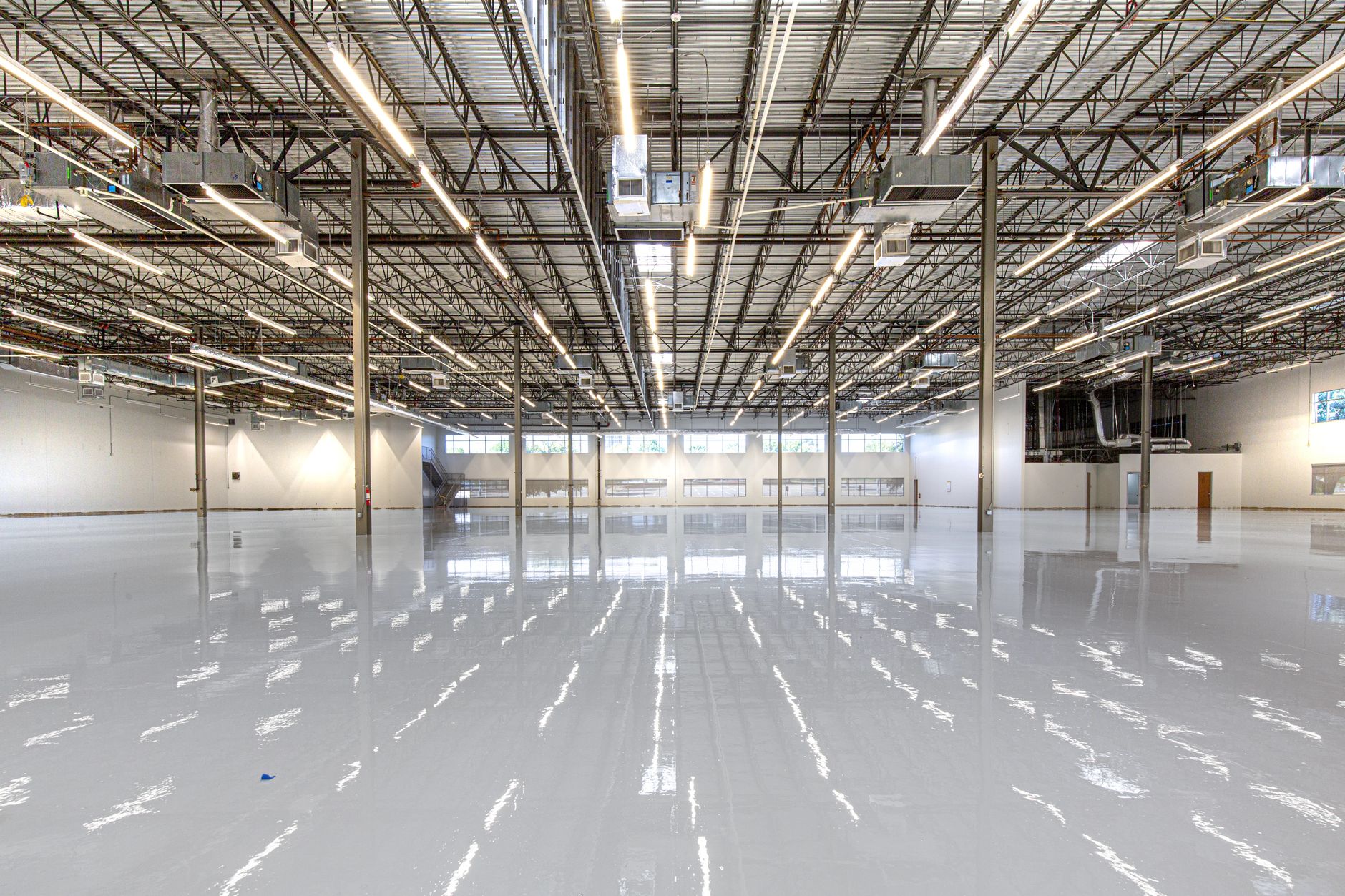
Professional epoxy garage floor installation requires ambient temperatures between 50-90°F, with 60-80°F being the optimal range. Both the air and the concrete substrate must remain within this range during application and the first 24 hours of curing—cold concrete slabs cure improperly even if the air feels warm, leading to soft spots, poor adhesion, and premature failure.
Why does temperature matter for epoxy garage floor installation?
Temperature controls the chemical reaction that transforms liquid epoxy into a rock-hard surface. Epoxy flooring consists of two components—resin and hardener—that undergo an exothermic chemical reaction when mixed. This molecular bonding process is temperature-dependent: too cold and the reaction stalls, too hot and it races out of control. When temperatures drop below 50°F, the curing reaction slows dramatically, preventing proper molecular cross-linking and resulting in a floor that never fully hardens. Above 90°F, the reaction accelerates beyond the installer's control, trapping air bubbles and reducing working time to minutes instead of the necessary 30-45 minutes for proper application.
The quality of your epoxy matters enormously here. Big-box store kits contain only 30-50% actual epoxy solids—the rest is water or cheap solvents that evaporate during curing. These diluted formulations are already marginal in ideal conditions and become completely unreliable in cold weather. Premium epoxy flooring systems like Revolution Epoxy's commercial-grade 100% solids epoxy have far more tolerance for real-world conditions, but even professional materials demand proper temperature control during installation.
The chemical reaction behind epoxy curing
Epoxy curing is a thermosetting reaction: resin molecules cross-link with hardener molecules to form a dense polymer network. This chemical transformation generates heat (exothermic), which is why freshly applied epoxy feels warm to the touch. Temperature acts as a catalyst for this reaction—molecular movement increases with heat, allowing molecules to find and bond with each other efficiently.
Below 50°F, molecular movement slows to a crawl. The resin and hardener mix but fail to fully react, leaving unreacted pockets and weak cross-linking throughout the coating. The result isn't just slow curing—it's incomplete curing. At 60-80°F, the reaction proceeds at the engineered pace, achieving full mechanical strength within 72 hours and complete chemical cure within 7 days. Above 90°F, the reaction accelerates unpredictably, with the coating potentially gelling before proper application and leveling can occur.
For Northwoods winters in Wisconsin, Michigan, and Minnesota, this presents a real challenge. Unheated garages routinely sit at 20-35°F from December through March—well below the minimum threshold for reliable epoxy installation.
What happens when epoxy is installed too cold
Cold-weather epoxy failures follow a predictable pattern. The coating appears to set initially, giving a false sense of success, but problems emerge within weeks or months. Incomplete molecular curing leaves the surface permanently softer than engineered specifications, causing vehicle tires to leave marks and hot tires to indent the surface. Poor adhesion to the concrete substrate results from the coating never achieving proper bond strength—the floor literally didn't "grab" the concrete at the molecular level.
Surface cloudiness and haziness develop as moisture becomes trapped during the sluggish curing process. In properly cured epoxy, moisture evaporates through the coating as it sets. In cold conditions, the coating skins over before interior moisture escapes, creating a milky appearance that cannot be corrected. Cure times extend from the normal 24-48 hours to 5-7 days or longer, and even then, the floor may never reach full hardness.
Bubbling becomes common as well. Cold epoxy is more viscous, trapping air during mixing and application. The slow cure means those bubbles never have a chance to rise and pop before the surface sets. The finished floor looks dimpled and pitted—visually unappealing and difficult to clean.
What is the ideal temperature range for epoxy garage floors?
The professional installation standard for epoxy garage floors is 50-90°F ambient temperature, with 60-80°F representing the optimal "sweet spot" where epoxy cures predictably and achieves maximum performance. Both air temperature and concrete substrate temperature must fall within this range—not just one or the other. Humidity should remain below 85% relative humidity to prevent moisture interference with the curing reaction.
This isn't a guideline; it's chemistry. Epoxy resin manufacturers engineer their formulations to cure properly within these parameters. Step outside this range and you're conducting an uncontrolled chemical experiment with your garage floor as the test subject. Professional installers verify conditions before beginning work. DIY installers attempting winter garage projects rarely have the equipment to measure or control these variables, which explains the epidemic of failed box-store epoxy jobs across the Northwoods region each spring.
Substrate temperature vs. ambient temperature
The concrete slab temperature matters more than the air temperature around it. Concrete is a thermal mass—it absorbs and retains temperature far longer than air. Your garage air might feel comfortable at 65°F after running a space heater for a few hours, but the concrete slab beneath could still be 40°F, having absorbed weeks of winter cold.
Professional installers use infrared thermometers to measure concrete surface temperature directly. The slab must be at least 50°F, ideally 60°F or higher, before epoxy application begins. In unheated Northwoods garages, concrete slabs can remain near-frozen for weeks after outdoor temperatures warm up. The slab is in direct contact with frozen ground below, conducting cold continuously.
This temperature lag explains why early spring installations often fail. A 60°F April day feels warm enough, but the garage slab is still 45°F from three months of winter. The homeowner applies epoxy, the air temperature seems fine, and the floor never properly cures. Revolution Epoxy accounts for substrate temperature in every installation, pre-heating spaces for 24-48 hours to warm the slab itself, not just the surrounding air.
Can you install epoxy garage floors in winter in Wisconsin, Michigan, or Minnesota?
Yes, with professional climate control equipment and processes. Revolution Epoxy serves Wisconsin, Michigan, and Minnesota year-round, performing winter installations from December through March with identical quality and durability to summer jobs. The difference is professional-grade temperature management: industrial propane heaters, garage sealing techniques, and continuous temperature monitoring from prep through initial cure.
The professional winter installation process begins 24-48 hours before application day. Portable heaters are positioned to warm both the garage air and concrete slab to 60-75°F. The space is sealed to retain heat—garage doors closed, gaps around doors weatherstripped temporarily, and heat maintained continuously. On installation day, temperatures are verified with infrared thermometers before any material is mixed. During application and throughout the critical first 24 hours of curing, heaters remain in place and temperatures are monitored.
This is why DIY winter installs fail consistently. Homeowners lack industrial heating equipment, cannot seal garage spaces effectively, have no way to monitor concrete temperature accurately, and cannot maintain controlled conditions for 48+ hours. A $50 space heater running for a few hours before application doesn't come close to what's required. Professional installation includes all climate control as standard—no extra charges, no homeowner effort, and guaranteed results regardless of the blizzard happening outside.
How Revolution Epoxy controls winter installation conditions
The climate control process for winter epoxy installations is systematic. Industrial propane heaters capable of 80,000-150,000 BTU output are brought to the site—these aren't consumer space heaters but construction-grade equipment designed to heat large spaces quickly. Garages are temporarily insulated using thermal blankets or foam board on doors and sealing gaps that would allow heat loss.
Pre-heating begins 24-48 hours before installation day. This duration isn't arbitrary—it's the minimum time required for thick concrete slabs to absorb heat and reach uniform temperature throughout their depth. Surface heating alone isn't sufficient; the slab must be warm all the way through to ensure proper epoxy adhesion.
During installation, temperatures are checked every 30-60 minutes using both ambient thermometers and infrared guns pointed at the concrete surface. The 100% solids commercial-grade epoxy used by Revolution Epoxy is more forgiving than diluted big-box products, but it still requires proper temperature for optimal performance. After application, heaters remain in place for at least 24 hours—the critical initial cure window where molecular cross-linking occurs. Only after the coating has hardened sufficiently is climate control equipment removed.
This process is standard across every winter installation in the Northwoods region. Homeowners schedule their installation, Revolution Epoxy arrives with all necessary equipment, and the transformation from dull concrete to showroom-quality floor happens in 1-2 days regardless of whether it's January or July outside.
Why big-box epoxy kits fail in cold garages
Big-box store epoxy kits are engineered for warm conditions and DIY application—they contain 30-50% epoxy solids with the remainder being water, solvents, or fillers that reduce cost and extend shelf life. This dilution already produces a weaker coating than professional 100% solids epoxy. In cold conditions, these marginal products become completely unreliable.
Water-based epoxy kits are especially temperature-sensitive. Water freezes at 32°F and doesn't evaporate efficiently below 50°F, so any cold-weather application traps moisture in the coating, creating permanent cloudiness and preventing proper cure. Low-solids solvent-based kits fare slightly better but still require ideal conditions because there's simply less actual epoxy present to form a strong coating—the margin for error is zero.
Beyond the inferior chemistry, DIY installers lack climate control equipment. A homeowner attempting installation in their unheated garage during a Wisconsin February is working in 30-40°F conditions with a product that requires 60-80°F. The result is predictable: the coating never fully hardens, begins peeling within months, develops soft spots under vehicle traffic, and ultimately requires complete removal and professional re-installation. The "$200 savings" from the DIY approach costs $1,500-2,500 to correct when the floor fails.
Professional 100% solids epoxy combined with controlled installation conditions eliminates these variables entirely. The coating performs as engineered because the conditions match the engineering specifications.
What are the risks of installing epoxy floors below 50°F?
Installing epoxy below 50°F produces multiple failure modes, often invisible initially but catastrophic over time. Incomplete curing within 72 hours is the first sign—the floor remains slightly tacky or develops "soft" areas that never harden. Bond strength to the concrete substrate decreases by 40-60% compared to proper-temperature installation, meaning the coating is barely clinging to the surface rather than being molecularly bonded.
Surface defects appear as the coating attempts to cure: clouding or hazing from trapped moisture, an uneven sheen where some areas cross-link faster than others, and visible bubbles that never had a chance to escape the viscous, cold epoxy during application. The floor may look acceptable immediately after application, but within 2-4 weeks these defects become obvious.
Long-term failure is even more concerning. Vehicle traffic causes accelerated wear within 6 months—hot tires leave permanent marks, turning vehicle wheels create scuff patterns, and delamination begins at edges where stress concentrates. Winter salt and de-icing chemicals penetrate the improperly cured coating, attacking the concrete beneath and causing edge lifting. By the first year, the floor looks worse than the bare concrete it was meant to cover.
These aren't hypothetical risks—they're documented failure patterns seen across thousands of DIY cold-weather installations throughout the Northwoods region. Professional temperature-controlled installation eliminates every one of these failure modes because the epoxy is allowed to cure as the manufacturer engineered it.
How long does epoxy need to cure in winter conditions?
At proper temperatures between 60-80°F, professional 100% solids epoxy reaches key milestones on a predictable schedule: light foot traffic after 24 hours, vehicle traffic after 72 hours, and full chemical cure at 7 days. "Light foot traffic" means walking across the floor; "vehicle traffic" means parking and driving on it; "full cure" means the coating has achieved maximum hardness, chemical resistance, and bond strength.
In cold conditions near the 50°F minimum threshold, these timelines approximately double. Light foot traffic requires 48 hours, vehicle traffic 5-7 days, and full chemical cure 14-21 days. The coating is progressing through the same chemical reactions but at half speed due to reduced molecular activity. This extended timeline isn't just inconvenient—it represents a coating that's vulnerable to damage for twice as long.
Below 50°F, cure times become unpredictable and the floor may never reach full cure. The chemical reaction essentially stalls, leaving a floor that remains perpetually "soft" compared to properly cured epoxy. Some areas may cure faster than others due to micro-variations in temperature, creating an uneven surface with inconsistent hardness.
Revolution Epoxy's installation process includes temperature maintenance through the initial 24-hour critical cure window. This controlled environment ensures customers can use their garage on the standard timeline—walk on it tomorrow, park on it in three days—regardless of the sub-zero temperatures outside. The 1-2 day total installation timeline remains consistent year-round because the curing environment is controlled, not left to chance.
Do you need to heat the garage before epoxy installation?
For winter installations, yes—pre-heating is mandatory, not optional. The garage and concrete slab must be brought to at least 50°F, preferably 60-75°F, for 24-48 hours before epoxy application begins. This pre-heating period serves two purposes: warming the air to proper ambient temperature for application, and more importantly, raising the thermal mass of the concrete slab to ensure proper adhesion and curing at the substrate interface.
Concrete thermal mass is enormous. A typical two-car garage slab weighs 15-20 tons. That mass has been soaking up winter cold for months. Surface heating with portable heaters warms the top inch of concrete within hours, but the slab's core remains cold, conducting heat away from the surface continuously. Twenty-four to 48 hours of sustained heating brings the entire slab thickness to uniform temperature, preventing the "cold sink" effect that would draw heat out of the freshly applied epoxy and stall the curing reaction.
Professional installers bring and operate all heating equipment—homeowners do nothing. Revolution Epoxy includes complete climate control as part of the installation service. Industrial heaters, fuel, monitoring equipment, and extended run time to maintain temperature through initial cure are standard, with no extra charges. The alternative—asking homeowners to heat their garage for two days and maintain temperature overnight—is impractical and unreliable.
DIY installers attempting winter garage projects rarely appreciate the pre-heating requirement. They might run a space heater for a few hours, check that the air "feels warm," and proceed with installation. The concrete slab is still 40°F, the epoxy never bonds properly, and the floor fails. Professional preparation eliminates this failure mode entirely.
Is winter actually a good time to install epoxy garage floors?
Winter is an excellent time for professional epoxy garage floor installation—often better than summer. Garages are typically emptied of seasonal storage items, boats, and ATVs, making preparation easier. Homeowners have better availability during holiday periods and post-holiday weeks to schedule installation. Professional installers have open schedules since DIY customers avoid winter projects, resulting in faster scheduling—often within 1-2 weeks of inquiry rather than the 4-6 week wait common in spring and summer.
From a technical standpoint, winter installation with proper climate control eliminates the high humidity that can complicate summer applications in the Northwoods region. Summer humidity above 85% can interfere with epoxy curing, causing surface blushing or slowing the reaction. Winter air is naturally dry, and heated indoor spaces are even drier—ideal conditions once temperature is controlled.
Revolution Epoxy performs winter installations across Wisconsin, Michigan, and Minnesota throughout December, January, and February with zero seasonal performance difference. The finished floor is identical in appearance, hardness, adhesion, and durability whether installed in January or July. With professional climate control, season becomes irrelevant to outcome—only the process changes, not the result.
The visual transformation from dingy winter concrete to stunning showroom floor also provides a psychological boost during the darkest months of the year. Homeowners completing garage renovations in January report higher satisfaction than those waiting until spring, simply because the upgrade happens during a season when most home projects are on hold. Get a free quote for your garage transformation—winter availability is often the best of the year.
Frequently Asked Questions
Can epoxy garage floors be installed in freezing weather?
Yes, but only with professional climate control. The epoxy itself and the concrete substrate must be maintained between 50-90°F during application and initial curing. Revolution Epoxy uses industrial heaters to pre-warm garages 24-48 hours before installation and maintains proper temperature throughout the process. Attempting installation in an unheated garage during Northwoods winters will result in incomplete curing, poor adhesion, and premature failure.
What temperature does concrete need to be for epoxy flooring?
Concrete substrate temperature must be at least 50°F, with 60-80°F being optimal. Concrete holds cold much longer than air, so even if your garage air feels warm, the slab may still be too cold. Professional installers use infrared thermometers to verify slab temperature before beginning. Revolution Epoxy pre-heats garage spaces for 24-48 hours to ensure the concrete itself reaches proper temperature, not just the surrounding air.
How long does epoxy flooring take to cure in cold weather?
At proper temperatures (60-80°F), professional 100% solids epoxy allows light foot traffic in 24 hours and vehicle traffic in 72 hours. In cold conditions near 50°F, these timelines can double. Below 50°F, epoxy may never fully cure, remaining soft and prone to damage. Revolution Epoxy maintains controlled temperatures during the critical first 24 hours, ensuring your floor cures on schedule regardless of outside weather conditions.
Why do big-box epoxy kits fail in winter?
Big-box epoxy kits contain only 30-50% solids (the rest is water or solvents), making them extremely temperature-sensitive. Combined with homeowners' inability to heat and control garage temperature for 24-48 hours, these kits result in soft, peeling floors. Professional-grade 100% solids epoxy used by Revolution Epoxy is more resilient, but still requires proper temperature control—which is why professional installation includes climate management equipment as standard.
Do I need to heat my garage before epoxy installation?
For winter installations, yes—the garage and concrete slab must be pre-heated to at least 50°F, ideally 60-75°F, for 24-48 hours before application. This warming period is critical because concrete retains cold and takes much longer to heat than air. Revolution Epoxy handles all climate control as part of the installation service. We bring industrial heaters, seal the space, and monitor temperatures so homeowners don't need to do anything.
Is winter a good time to install garage epoxy floors?
Winter is actually an excellent time for professional epoxy installation. Garages are typically emptied of stored items, professional installers have better availability, and floors cure without the high humidity that can complicate summer installs. Revolution Epoxy performs winter installations year-round across Wisconsin, Michigan, and Minnesota with the same durability and finish quality as warmer months. With professional climate control, there is zero performance difference between seasons.
What happens if epoxy is installed below 50 degrees?
Epoxy installed below 50°F undergoes incomplete chemical curing, resulting in soft spots, poor adhesion to concrete, surface cloudiness, and significantly reduced bond strength (40-60% weaker). The floor may feel set initially but will fail under vehicle traffic within months—peeling at edges, developing sticky areas, or showing premature wear. These problems often aren't visible immediately, appearing weeks later. Professional temperature control eliminates this risk entirely.